[PEAK Challenge] [MapleStory] How free-to-play ends up charging for fun
WarmSick
![[PEAK Challenge] [MapleStory] How free-to-play ends up charging for fun](https://peak-file.nexon.com/uploads/20260811_1253_7df2f343.png)
[Participating in the Nexon PEAK Post Challenge]

In my previous post, someone from Nexon PEAK left a comment on my blog suggesting I join the challenge. My first reaction was basically, “Oh, this is a thing?” and since I had already been meaning to write something about MapleStory at some point, I was happy to take part.
MapleStory has been around for a long time, so of course it has changed in countless ways, but there is one shift in particular that has stood out to me over the past few years. The basic answer to the question of “what, exactly, should be sold to the player?” seems to be changing.
A structure chart I scribbled out before High Mountain had even been released
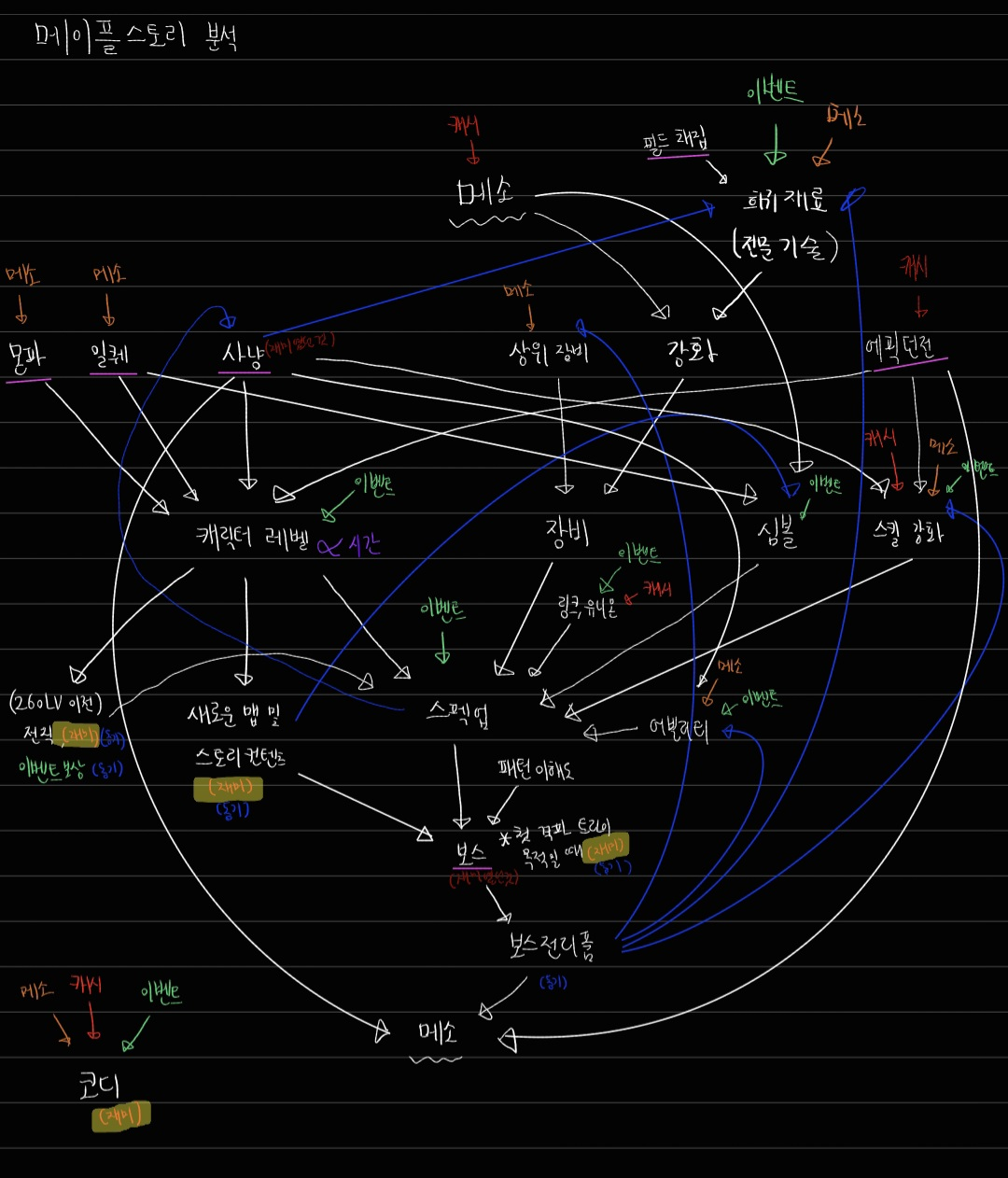
A MapleStory structure chart I doodled up on a whim. Plenty of it is wrong, but it was still enough to make the underlying reality of a free-to-play game feel visible...
Back when the idea of Epic Dungeons was first revealed in a showcase, I remember wondering, “What kind of structure is MapleStory actually built on?” and trying, in my own way, to map out the game’s progression system.
Looking at it now, it is pretty cluttered, and a lot of it is not especially accurate. Even so, there is one reason I wanted to bring it back out. It is because the way MapleStory used to deliver fun, and the way it does so now, feel meaningfully different to me.
The past: spend money, or spend a lot of time
In the past, MapleStory’s progression structure was fairly simple. You either spent all day grinding and earned mesos inefficiently, or you paid, secured mesos that way, and bought high-end items made by other players. Since crafting and enhancing gear yourself often was not especially efficient for the cost, buying finished items through trading was usually the natural choice.
The problem was the process of getting the mesos needed to buy those items. If you were not going to pay, you had to invest a great deal of time; if you wanted to shorten that time, you had to spend money. In the end, for the player, the core choice in the progression structure came very close to “Do I pay with time, or do I pay with money?” And because of that, once you got past a certain point, it became difficult to fully experience the fun of progression without spending.
The past: a structure where even spending money could not buy you that much more fun
That does not mean paying solved everything, either. If anything, the monetization model of the time had a different problem. If you wanted to progress through spending, the most efficient route was to buy strong items all at once and make a huge jump in combat power immediately. For example, imagine a player clearing Suu and Damien in roughly all-Epic gear who one day decides, “All right, I’m going to play Maple properly now,” and then buys double Legendary weapon, secondary, and emblem, along with strong gear, in one go. Their combat power shoots up almost instantly. The issue is that, in the process, a large part of the sense of achievement that would normally come from gradually building toward bosses like Lucid or Will, learning patterns, failing repeatedly, and finally winning, disappears as well.
To me, the “fun of challenge” in MapleStory does not come from simply making the numbers bigger. It comes from the process itself: growing stronger bit by bit with higher-tier bosses in mind, while the player also becomes more familiar with the patterns, until character growth and player mastery rise together and finally culminate in a clear. But when strong items can just be bought all at once, that whole process gets compressed. You do become stronger by paying, yes, but you also skip over the middle stretch of content and challenges that strength would otherwise have let you enjoy. In other words, old MapleStory was not structured so that spending more money let you buy proportionally more fun.
The present: moving toward selling not just “efficient rewards,” but a well-made play experience
The reason I put the Nexon PEAK Challenge tag on this post and then spent the opening section criticizing older MapleStory at some length is that this is the part I actually wanted to talk about. I like the direction MapleStory has been taking lately. Current MapleStory, to my eye, is starting to make use of the strengths of free-to-play while moving a little closer to the package-game model of “you pay money, and in return you get a genuinely worthwhile kind of fun and experience.” As I said earlier, the central problem with the old monetization structure was that spending money made your character too strong too quickly, and the fun of the in-between content got skipped along with it.
Recently, MapleStory seems to be trying to solve much of that through pass-style BM and various growth events. What I found especially notable here was not simply the amount of rewards being handed out, but the balance between those rewards and the content itself. A typical pass-style BM usually works like this: “Play consistently, and we’ll give you good items.” That is a perfectly valid approach, of course. But most passes, regardless of the player’s actual curve of interest, tend to focus on how many rewards they can give and how efficiently they can deliver them.
MapleStory’s recent progression design, by contrast, seems to be aiming for something a little different by tying together multiple growth devices such as Item Burning, Challengers Buff, and pass rewards. The logic feels more like, “If you’ve beaten this boss at this point, we’ll grow your character enough for the next boss attempt to feel appropriate,” or, “Once you reach this level, we’ll grow you enough that the next piece of content can be enjoyed properly.”
In actual play, too, whenever I first ran into a new boss, I got the impression that the progression intervals had been tuned with surprising care so that my character landed in a state that was neither absurdly overpowered nor hopelessly weak. As a result, simply by buying the pass and following the event flow, the player experiences a fairly steady growth curve, and at each stage takes on a new boss at an appropriate difficulty. In other words, the pass has started functioning not merely as a “good-value bundle of items,” but as a device for delivering one carefully tuned play experience.
I have spent quite a while talking about money, and about BM, but the reason I think this matters is simple: a structure that says, “If we charge this much, we will provide this much fun,” seems to me one of the healthier forms the content industry, games included, can take.
At its core, the content industry is supposed to create value in the form of new experiences, emotions, and enjoyment, and be paid in return. Yet I think the reason free-to-play BM has been viewed so negatively for so long is that it has too often leaned not on new experiences or new fun, but on human compulsions and competitive instincts. The addictiveness produced by randomness, the desire to be even a little stronger than other people, or the urge to present oneself more impressively than others—these things often became the real engine of BM. Rather than offering genuinely new experiences, they repeatedly stimulated desires that were already there and turned them into spending, often at prices that became far too high. So in that sense, I think free-to-play BM itself came to be seen as something dangerous, or at least something to be approached with caution.
From that perspective, MapleStory’s recent attempts are quite interesting. Rather than merely selling progression numbers, it is making the pace of growth and the experience of taking on content part of the product itself. Package games and free-to-play games have long made money in completely different ways. The former sold new content and new experiences; the latter evolved by monetizing repeated play and the desire to grow stronger. MapleStory’s recent changes feel like an attempt to find the overlap between those two models. And I found that genuinely impressive: even while keeping the free-to-play structure intact, it suggests that a better play experience can still be designed within that structure in proportion to what the player pays.
The present: using seasonal bosses to provide a new “fun of challenge” each time
Starting with “Kai,” the boss from the previous Challengers season, MapleStory has been giving players a new challenge every vacation season.
Personally, as someone who likes soulslike games, I am very familiar with the feeling of a new DLC arriving and thinking, “I’m paying for a new area, a new boss, and a new combat experience.” From that angle, MapleStory’s recent direction with seasonal content has felt quite positive to me as well.
There is the fun of growing and competing within the new environment of the Challengers server, and at the same time each season brings a new boss and a new combat experience.
So what you end up with is a combination of the long-term pleasures of progression and competition—something free-to-play games are particularly good at building—and a package-game-like structure that keeps supplying new content. And as a slight aside, Kai, the Adversary, Meyrin—MapleStory’s boss design has become quite enjoyable lately. To the point that I find myself thinking, “Did some exceptionally capable combat designer join the Maple team?ㅋㅋㅋ” I have known MapleStory for a very long time, but in the past it was actually quite rare for me to fight a boss and come away feeling that the combat itself was fun.
Recent bosses keep asking the player to make meaningful choices mid-fight. Do you keep pressing the attack, or back off and play safely? In a given pattern, do you take the risk and push damage, or wait for the next opening? Every one of those choices carries its own risk and reward, and compared to before, the player has much more room to shape the flow of the battle through their own judgment. In the end, a seasonal boss stops being merely a new source of rewards and becomes “a new piece of combat content to experience this season”. And that fits neatly with the broader direction I have been talking about all along—the idea of charging money in exchange for delivering actual fun.
Conclusion
Korean games have gone through an unusually long period of experimentation and development with the free-to-play model, even by global standards. Personally, though, I have often felt that a great deal of that development was less about improving the medium and more about refining ways to exploit people’s psychological weak points—in other words, about advancing what you might call “high-toxicity BM.” So even while watching free-to-play games evolve, I always carried a certain amount of discomfort with me.
That is why the direction MapleStory has been showing recently feels genuinely welcome. Rather than simply selling stronger items or faster growth, it is trying to design a structure in which players follow a steady progression curve, experience content at the right level of difficulty, and are continually given new bosses and new challenges. In the end, I think the important question is not “how much can you sell?” but “how good an experience can the player get for the money they spend?”
Lately, MapleStory seems to be finding a fairly convincing answer to that question while still preserving the strengths of free-to-play. Going forward, I hope we see more attempts not just to develop BM for its own sake, but to make that BM work together with the game’s actual fun and produce new experiences for players. I find myself hoping that MapleStory will continue to show that even in a free-to-play game, the obvious but difficult principle of “charging money and selling fun” really can hold.
![[피크 챌린지] 파티플레이는 이맛이지! 마비노기모바일 파티플레이 경험](https://peak-file.nexon.com/uploads/20260719_0540_f2fdce2c.png)
![[피크 챌린지] 몬컬부터 마이홈 가구까지, 수집가들의 도파민을 자극하는 넥슨 '메이플스토리' 컬렉션 요소 총정리](https://peak-file.nexon.com/uploads/20260730_0920_07be83b6.png)
![[피크 챌린지] 친구와 하기 좋은 게임 FC온라인!](https://peak-file.nexon.com/uploads/20260619_0412_378630ab.png)
![[피크 챌린지] 이 게임 유지비 중 절반 이상은 성우에 쓰고 있는 것 같다는 합리적 의심이 들고 있다.](https://peak-file.nexon.com/uploads/20260630_1111_54ed0bb2.png)