[PEAK Challenge] MapleStory Party Quests: I Never Knew Playing Together Could Be This Much Fun
드록바원툴
![[PEAK Challenge] MapleStory Party Quests: I Never Knew Playing Together Could Be This Much Fun](https://peak-file.nexon.com/uploads/20260720_0314_f4833dfd.jpg)
Taking part in the NEXON PEAK Post Challenge
When the lower levels of MapleStory started to feel boring, party quests changed that part of the game completely for me. Thanks to the Moon Bunny Party Quest and the Ludibrium Party Quest, the time I’d spent hunting alone became time spent achieving something together.
Today, I want to share how MapleStory’s party quests helped me break out of that low-level boredom.

Honestly, the early levels of MapleStory can get boring. Keep fighting the same monsters on the same map long enough, and eventually your hands just stop moving. You stick with it for a while, watching your EXP bar inch upward, until you finally close the game. If you’ve played MapleStory for a long time, you’ve probably been through that cycle at least once.
Discovering party quests changed that feeling. Instead of hunting alone, I was clearing stages with other players, and suddenly the game felt different. In pre-Big Bang MapleStory, party quests were a key part of the game for players tired of playing solo, offering a faster way to level up than hunting alone. Back then, you had to travel to the right area yourself to take part. That meant heading to Henesys for the Moon Bunny PQ or to Ludibrium for the Ludibrium PQ, then putting together a party there. Even the journey was a chance to start talking with your party members.
Those were the days when a quick “Anyone want to do a party quest?” in channel chat would soon bring people together. Looking back, checking each other’s levels and classes, then joining a party if everything lined up, was fun in its own right. There was no matchmaking system like there is now, so you had to do the legwork yourself. But that extra effort actually helped us feel closer as a party.

The Moon Bunny Party Quest is a PQ you enter from Henesys. Party members call out the colors of the rice cakes they’ve collected in chat and work out the matches together. Everyone uses shortened names for light green, blue, purple, pink, brown, and yellow. At first, I wasn’t sure what to make of it—was I playing a game or taking a color quiz?
Once I tried it, though, matching colors and talking with the party turned out to be surprisingly fun. Everyone had to quickly post their rice cake colors in chat, and the party could move on together when the right colors came up. That made every member’s role important. If someone called out a color too late or typed the wrong one, we couldn’t move forward.
At first, I didn’t know that collecting brown and purple together meant you had to reverse their order in chat to avoid the filter. On my first PQ, I remember typing “갈보,” the Korean shorthand for brown and purple, only for it to get filtered and earn me a scolding from my party members. Little mistakes like that became part of what made party quests funny. When we finally collected all 10 rice cakes and cleared the quest, everyone celebrated together.
There was also a bonus reward for collecting up to 20 more rice cakes. We’d encourage each other to keep collecting, and before we knew it, time had flown by. That’s part of the appeal of party quests: accomplishing something together, even with people you’ve only just met. The Moon Bunny PQ offered the simplest, most lighthearted way to experience that.
The Ludibrium Party Quest was much more complicated than the Moon Bunny PQ. You entered from the 101st floor of Eos Tower and needed a full party of 6 to proceed, so even forming the party took some strategy. To get through certain stages, you needed at least 1 Magician who could use Teleport, 1 Thief who could use Dark Sight, and a Hunter or Crossbowman.
Without the right lineup, you either couldn’t start the PQ at all or would get stuck at a particular stage. We had to think about the mix of classes from the moment we formed a party, and players got used to seeking out whichever classes they still needed. Messages like “LPQ looking for a Magician” and “Any Thieves want to join us?” filled the Eos Tower chat back then.
What set LPQ apart was that each class had its own role. Magicians moved party members with Teleport, while Thieves used Dark Sight to pass through certain sections. With everyone responsible for something different, the whole party had to stay focused to clear each stage. One person’s mistake could affect everyone, so communication was essential.
We had to work together from the start, collecting passes for the party leader in stage 1 and exchanging signals about the trap map in stage 2. Breaking the second box in stage 2 sent everyone on the map into the trap map. To avoid that, we sent one person into the trap map first and waited for their “ㄱㄱ” signal before going through the portal. Get the timing wrong, and the whole party could end up in the trap map, having to start over.
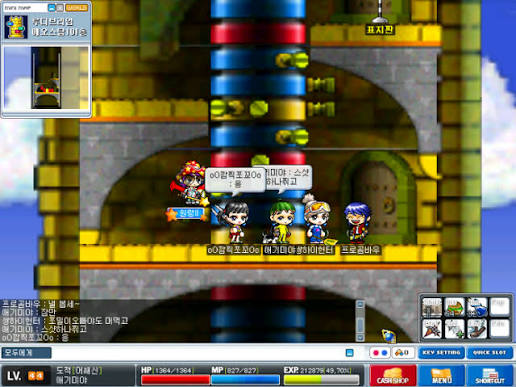
The most notorious part of the Ludibrium Party Quest was stage 8—a game of chance with 1/126 odds. Getting stuck there sometimes meant starting again from the beginning. When that happened, party members tended to react in one of two ways: some got genuinely angry, while others laughed and said, “Let’s go again.”
What surprised me was how often people stayed to try again together, even after getting stuck at stage 8. By then, working through the stages had already brought us a little closer. We’d started as strangers, but after a few stages, we were naturally trading jokes and laughing off mistakes. Those moments made party quests more than just a way to level up.

Alishar, the final boss of the Ludibrium Party Quest, was pretty intimidating: level 52, with 125,000 HP. It kept the party under pressure with status effects like Seal and Darkness, while summoning Chronos and Platoon Chronos as well. Its long-range magic attacks hit hard, so the Cleric had to keep casting Heal for everyone to survive.
So much depended on how well the Cleric played. If they were Sealed and couldn’t cast Heal, the entire party could suddenly be in danger. Clerics had to bring plenty of potions to cure status effects, while the rest of us kept an eye on how they were doing as we fought. Everyone had to look out for each other.
I remember how excited we all were the first time we defeated Alishar. The boss EXP was shared among us, and watching all our EXP bars fill felt completely different from hunting alone. Clearing all 9 stages and defeating Alishar within the 59-minute, 30-second time limit gave me a sense of accomplishment I still remember.
Once I started alternating between the Moon Bunny PQ and the Ludibrium PQ, the lower levels stopped feeling boring altogether. Unlike hunting alone on the same map, party quests gave us a different task at each stage. Between those tasks and talking with the party to work through them, there was always something to focus on.
I earned EXP faster than I did grinding alone, but what mattered more was how much fun we had together. Sometimes a few party quests were enough to turn strangers into friends, and we’d end up joining each other for more PQs later. Quite a few of the friendships I made in MapleStory began in party quests.
If you’re finding solo hunting at the lower levels boring, I really recommend trying the Moon Bunny PQ and the Ludibrium PQ. You’ll earn EXP faster than you would hunting alone, and there’s a particular kind of fun in talking with your party and working through each stage together. That feeling of accomplishing something with people you’ve only just met is something only party quests can offer.
Which MapleStory party quest stands out most in your memory? Let’s share our stories in the comments.
![[피크 챌린지] 독특한 퀘스트 디레지에 레이드 후기](https://peak-file.nexon.com/uploads/20260623_0222_f383d305.jpg)
![[피크 챌린지] 메이플랜드 2.0 드디어 출시되었다! 새로운 출발과 버닝월드 이벤트!](https://peak-file.nexon.com/uploads/20260620_0325_e10ca8a6.png)
![[피크 챌린지] 나와 함께해줄래..? 같이 하면 재미가 x10000 되는 둘이하기좋은 마비노기모바일](https://peak-file.nexon.com/uploads/20260719_0625_0219cde4.png)
![[피크 챌린지] 무과금 소과금도 충분히 즐겁다, 마비노기 모바일을 알뜰하게 즐기는 플레이 팁](https://peak-file.nexon.com/uploads/20260807_0327_012c4ebc.png)