[PEAK Challenge] Blue Archive Mika stayed with me all the more because she was voiced by Nao Toyama
폭풍같은주황호랑이31281
![[PEAK Challenge] Blue Archive Mika stayed with me all the more because she was voiced by Nao Toyama](https://peak-file.nexon.com/uploads/20260624_0128_e5ba72a0.png)
[Participating in the Nexon PEAK Post Challenge]
https://peak.nexon.com/post/1864
Hello, this is Edgar.
There are a lot of reasons we end up liking a game character.
Sometimes it’s because they’re strong,
sometimes it’s because the artwork is beautiful enough to catch our eye,
and sometimes we only grow attached after seeing their story.
But every so often, just one voice
can completely change the way a character feels.
When I saw this #게임성우 topic,
the first character I thought of
was Misono Mika from Blue Archive.
And if I’m going to talk about Mika,
it’s hard not to talk about voice actress Nao Toyama too.
Honestly, when I play games,
I’m not usually the type to check every voice actor’s name from the beginning.
If I end up liking a character, that’s usually when I look it up.
But Mika was a little different.
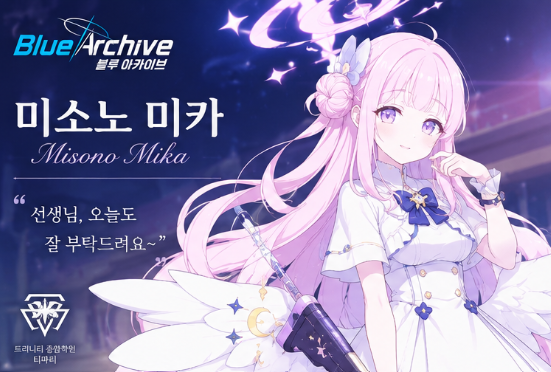
At first, I was drawn in by her design and the overall mood of the story,
but once I heard her voice,
I found myself thinking, “Ah, I know this voice from somewhere...”
When I looked it up, it was Nao Toyama.
Even people who don’t know much about voice actors
have probably heard Nao Toyama at least once
if they’ve watched a decent amount of anime.
One well-known example is Rin Shima from Yuru Camp△.
It was a role that really captured the feeling of a character
who quietly enjoys camping on her own.
What impressed me was how her voice never felt overly showy,
and yet the character’s personality still came through clearly.
You also can’t leave out Chitoge Kirisaki from Nisekoi.
She’s a bright, energetic character,
but the performance isn’t just noisy for the sake of it.
It also carries her pride and that sense that she can’t quite be honest.
Even though it’s the same voice actress,
if you compare Rin Shima and Chitoge,
you can really feel how different the acting texture is.
There are also roles with a strong idol image,
like Kanon Nakagawa in The World God Only Knows,
and calmer characters with a more distinctive atmosphere,
like Reina Prowler in Macross Δ.
When I think through her work one title at a time,
I don’t see Nao Toyama as just a voice actress with a pretty voice.
She feels more like someone who knows how to match a character’s emotional temperature.
When she plays a bright character, she sounds unmistakably bright,
and when she plays a calmer one, the warmth in her voice softens.
But either way,
it never feels forced.
To me, that’s Nao Toyama’s greatest strength.
Voice acting in games is a little different from acting in anime.
In anime, emotions build over the course of an entire scene,
but in games, one short line,
one login voice clip,
one brief word in battle,
or one small reaction on the character screen
can shape your whole impression of a character.
That’s why a voice has to feel convincing.

Even in a short line,
you should be able to feel what kind of person that character is.
That was exactly what stood out to me most
when Nao Toyama voiced Mika in Blue Archive.
At first glance, Mika seems like a bright and lovable character.
Her way of speaking is light,
her overall presence feels radiant,
and on the surface, she always seems to be smiling.
But as you keep following the story,
you start to realize that her brightness isn’t simply brightness.
Behind that easy, casual way of speaking,
there are more complicated emotions,
and inside those innocent-looking actions,
there’s hurt and anxiety too.
I don’t think a character like that is easy to play.
If you lean too far into the brightness, she starts to feel shallow,
and if you make her too heavy, Mika’s particular charm disappears.
The important thing is finding that middle ground,
and Nao Toyama’s Mika held that balance beautifully.
At first, she sounds cheerful.
There’s a slight playfulness to her,
and a warmth that makes her feel easy to approach.
But as the story’s emotions deepen,
you start to hear a faint sense of instability in that voice.
It’s not the kind of performance that relies on shouting or exaggerated bursts of emotion.
Instead, it feels like that bright tone slowly starts to crack.
That kind of acting stayed with me longer.
When people are really struggling,
they often don’t speak in a heavy tone from beginning to end.
On the surface, they pretend they’re fine,
they try to laugh it off,
and then at some point, it slips into their voice.
Mika’s voice had that feeling.
That’s why she didn’t feel like just a cute character to me,
but like someone I couldn’t help worrying about.
At its core, Blue Archive is a game where character appeal matters.
It has a battle system,
progression,
and collection elements,
but what stays with you in the end are the students’ stories and voices.
Especially with a character like Mika, whose emotions shift so much over the course of the story,
the voice acting can change your whole impression of her.
Some lines might feel a little excessive if you only read them,
but once they’re given a voice, there are moments when they just click.
On the other hand, if the voice doesn’t fit,
even a strong story can lose its sense of immersion.
Mika was the opposite.
Her voice made the character feel even more alive.
At first she comes across like a bright, cute student,
but after a certain point,
you start asking yourself, “Why does this character talk like this?”
To me, that’s the power of Nao Toyama’s performance.
If you’re familiar with Nao Toyama’s other work,
listening to Mika becomes even more interesting.
When I think of Rin Shima from Yuru Camp△,
the first image that comes to mind is that calm, quiet voice.
When I think of Chitoge from Nisekoi,
I think of bright, vivid energy.
But Mika doesn’t fit neatly into either side.
She’s bright, but somehow uneasy,
light on the surface, but carrying a heaviness somewhere inside,
and there’s a quiet loneliness hidden inside her cute way of speaking.
That, to me, was the heart of Mika’s performance.
When a voice actor truly understands a character and performs them that way,
players naturally end up lingering on that character longer.
For me too, regardless of Mika’s strength or popularity,
she was a character I found myself clicking on more often because of her voice.

I found myself checking her lines one by one,
and in memorials or story scenes,
I kept listening for those small changes in her voice.
That kind of experience is pretty special in a game.
It’s more than just “a talented voice actress was involved.”
It’s the kind of performance that changes the way you interpret the character.
Mika was that kind of character for me.
Of course, I also think Blue Archive itself
is a game that uses character voices very well.
Even short lines carry a clear sense of character,
and the voices you hear in the lobby or through interactions
help close the distance between the character and the player.
That’s a pretty important part of a mobile collection game.
The more characters a game asks you to collect,
the more clearly each one needs to stand apart,
and voice acting plays a major role in making that happen.
Mika was an especially strong example of that.
Her bright outward design,
the weight of her story,
and the shifts in temperature within her voice
all came together and left a deep impression on me.
The reason I came to like Nao Toyama
isn’t just because her voice is pretty.
I really liked the way she gives each character a different texture,
while layering emotion into the performance without ever making it feel unnatural.
Rin Shima has a quiet loneliness,
Chitoge has lively, bouncing energy,
and Mika has an anxiety hidden behind brightness.
Even though it’s the same voice actress,
the emotion I remember is different for each character.
To me, that’s what good voice acting is.
When you play games,
sometimes you pull a character because of performance,
grow attached to them because of the story,
and keep coming back to them because of the voice.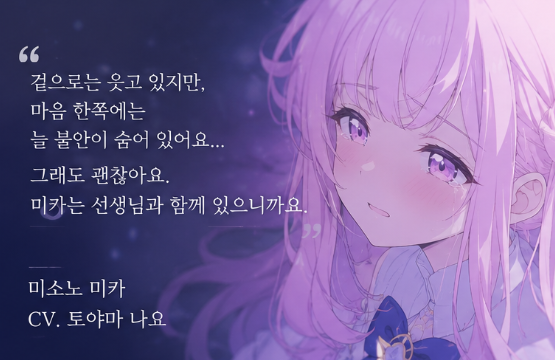
Mika was that kind of character for me.
While playing Blue Archive,
she was the character who made me think, “This character only feels complete when the voice is part of it too.”
So for this #게임성우 topic,
I wanted to talk about Mika from Blue Archive
and voice actress Nao Toyama.
Nao Toyama is a voice actress who has already shown her skill across many works,
and I think Mika is a character who shows those strengths especially well in a game.
A single line can make a character feel lighter,
or, on the other hand, much deeper.
Mika was the latter.
Her voice made me feel more attached to her,
it made the story scenes stay with me longer,
and it made me look at the character again.
If someone asked me why voice acting matters in games,
I’d want to point to Mika as an example.
Good dubbing doesn’t explain a character.
The moment you hear it,
you can simply feel what’s in that character’s heart.
That’s what Nao Toyama’s Mika was like for me.
#NPC01
#게임성우
#확률형아이템포함
#피크챌린지
#블루아카이브
#미소노미카
#토야마나오
#넥슨게임
![[피크 챌린지] 메이플스토리, 보스 클리어 목표 하나로 스펙업에 빠져든 이야기](https://peak-file.nexon.com/uploads/20260720_0336_120dad6f.jpg)
![[피크 챌린지] 와! 엘소드! 게임 굿즈도 다양하다!](https://peak-file.nexon.com/uploads/20260630_0527_f66505c4.jpg)
![[피크 챌린지] 유잠·레잠에 챌섭까지 지원! 현질 없이 알뜰하게 즐기는 넥슨 '메이플스토리'](https://peak-file.nexon.com/uploads/20260805_0744_6d17f908.jpeg)
![[피크 챌린지] 전투보다 옷장 빈칸이 더 신경 쓰였던 게임, 엘소드](https://peak-file.nexon.com/uploads/20260729_0711_94a6b690.png)